To see accurate pricing, please choose your delivery country.
 
 
United States
£ GBP
All Shops
Important Notice for US Customers

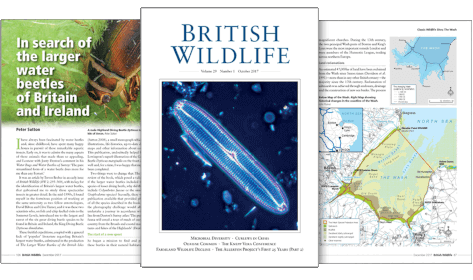
British Wildlife

8 issues per year 84 pages per issue Subscription only

British Wildlife is the leading natural history magazine in the UK, providing essential reading for both enthusiast and professional naturalists and wildlife conservationists. Published eight times a year, British Wildlife bridges the gap between popular writing and scientific literature through a combination of long-form articles, regular columns and reports, book reviews and letters.

Subscriptions from £33 per year

Conservation Land Management

4 issues per year 44 pages per issue Subscription only

Conservation Land Management (CLM) is a quarterly magazine that is widely regarded as essential reading for all who are involved in land management for nature conservation, across the British Isles. CLM includes long-form articles, events listings, publication reviews, new product information and updates, reports of conferences and letters.

Subscriptions from £26 per year
Academic & Professional Books  Organismal to Molecular Biology  Ethology

Bots and Beasts What Makes Machines, Animals, and People Smart?

By: Paul Thagard(Author)
312 pages, 25 illustrations
Publisher: MIT Press
Bots and Beasts
Click to have a closer look
Select version
  • Bots and Beasts ISBN: 9780262548540 Paperback Apr 2024 Not in stock: Usually dispatched within 1 week
    £25.00
    #266915
  • Bots and Beasts ISBN: 9780262045940 Hardback Oct 2021 Out of Print #256960
Selected version: £25.00
About this book Contents Customer reviews Biography Related titles

About this book

An expert on mind considers how animals and smart machines measure up to human intelligence.

Octopuses can open jars to get food, and chimpanzees can plan for the future. An IBM computer named Watson won on Jeopardy! and Alexa knows our favourite songs. But do animals and smart machines really have intelligence comparable to that of humans? In Bots and Beasts, Paul Thagard looks at how computers ("bots") and animals measure up to the minds of people, offering the first systematic comparison of intelligence across machines, animals, and humans.

Thagard explains that human intelligence is more than IQ and encompasses such features as problem-solving, decision making, and creativity. He uses a checklist of twenty characteristics of human intelligence to evaluate the smartest machines – including Watson, AlphaZero, virtual assistants, and self-driving cars – and the most intelligent animals – including octopuses, dogs, dolphins, bees, and chimpanzees. Neither a romantic enthusiast for nonhuman intelligence nor a sceptical killjoy, Thagard offers a clear assessment. He discusses hotly debated issues about animal intelligence concerning bacterial consciousness, fish pain, and dog jealousy. He evaluates the plausibility of achieving human-level artificial intelligence and considers ethical and policy issues. A full appreciation of human minds reveals that current bots and beasts fall far short of human capabilities.

Contents

Preface   xi
1 Attributing Minds to Machines and Animals   1
2 Prodigious People   21
3 Marvelous Machines   55
4 Amazing Animals   91
5 Human Advantages   131
6 When Did Minds Begin?   159
7 The Morality of Bots and Beasts   193
8 The Ethics of Artificial Intelligence   225

Acknowledgments   249
Notes   251
Index   283

Customer Reviews

Biography

Paul Thagard, a philosopher and cognitive scientist, is a Distinguished Professor Emeritus of Philosophy at the University of Waterloo. He is the author of Brain-Mind, Natural Philosophy, The Cognitive Science of Science, Hot Thought, Mind: Introduction to Cognitive Science (the last three published by the MIT Press), and many other books. He writes a popular blog for Psychology Today.

By: Paul Thagard(Author)
312 pages, 25 illustrations
Publisher: MIT Press
Media reviews

"Paul Thagard's Bots and Beasts makes a significant contribution to cognitive science and public policy by addressing how to assess the many aspects of intelligence and make ethical choices that respect the crucial needs of humans and animals. The book's comprehensive inventory of intelligent features and mechanisms can be used to compare intelligence across humans, animals, and machines. I recommend this book to AI researchers and practitioners, cognitive scientists, policymakers, corporate leaders, animal lovers, and anyone interested in intelligence and the world's future."
– Erik T. Mueller, Senior Director of Machine Learning Engineering, Capital One

"There is a lot to like in Thagard's book [...] an enjoyable read [...] continually thought provoking [...] Intelligence is likely a multi-faceted and multi-dimensional concept, and Thagard does illuminate many of its features for humans, animals, and machines."
Essays in Philosophy

" [...] written for an educated general audience [...] Thagard does an admirable job of providing clear yet succinct explanations [...] the book should be of particular interest to instructors teaching classes in philosophy of mind or philosophy of technology."
Teaching Philosophy

Current promotions
Great GiftsNew and Forthcoming BooksBritish Wildlife Magazine SubscriptionField Guide Sale 2025