To see accurate pricing, please choose your delivery country.
 
 
United States
£ GBP
All Shops
Important Notice for US Customers

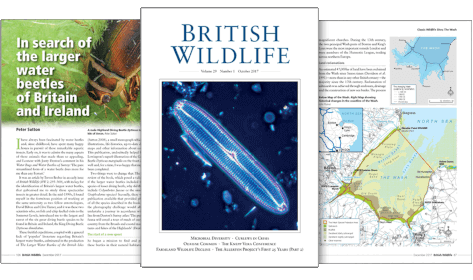
British Wildlife

8 issues per year 84 pages per issue Subscription only

British Wildlife is the leading natural history magazine in the UK, providing essential reading for both enthusiast and professional naturalists and wildlife conservationists. Published eight times a year, British Wildlife bridges the gap between popular writing and scientific literature through a combination of long-form articles, regular columns and reports, book reviews and letters.

Subscriptions from £33 per year

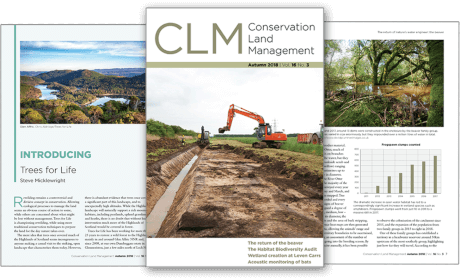
Conservation Land Management

4 issues per year 44 pages per issue Subscription only

Conservation Land Management (CLM) is a quarterly magazine that is widely regarded as essential reading for all who are involved in land management for nature conservation, across the British Isles. CLM includes long-form articles, events listings, publication reviews, new product information and updates, reports of conferences and letters.

Subscriptions from £26 per year
Academic & Professional Books  Reference  Physical Sciences  Mathematics

Quantitative Biosciences Dynamics across Cells, Organisms, and Populations

Textbook
By: Joshua S Weitz(Author)
408 pages, 16 colour & 159 b/w illustrations
Quantitative Biosciences
Click to have a closer look
Select version
  • Quantitative Biosciences ISBN: 9780691181516 Paperback Apr 2024 Not in stock: Usually dispatched within 1 week
    £50.00
    #266485
  • Quantitative Biosciences ISBN: 9780691181509 Hardback Apr 2024 Not in stock: Usually dispatched within 1 week
    £125.00
    #266484
Selected version: £50.00
About this book Customer reviews Biography Related titles Recommended titles

About this book

Quantitative Biosciences establishes the quantitative principles of how living systems work across scales, drawing on classic and modern discoveries to present a case study approach that links mechanisms, models, and measurements. Each case study is organized around a central question in the life sciences: Are mutations dependent on selection? How do cells respond to fluctuating signals in the environment? How do organisms move in flocks given local sensing? How does the size of an epidemic depend on its initial speed of spread? Each question provides the basis for introducing landmark advances in the life sciences while teaching students – whether from the life sciences, physics, computational sciences, engineering, or mathematics – how to reason quantitatively about living systems given uncertainty.

- Draws on real-world case studies in molecular and cellular biosciences, organismal behaviour and physiology, and populations and ecological communities
- Stand-alone lab guides available in Python, R, and MATLAB help students move from learning in the classroom to doing research in practice
- Homework exercises build on the lab guides, emphasizing computational model development and analysis rather than pencil-and-paper derivations
- Suitable for capstone undergraduate classes, foundational graduate classes, or as part of interdisciplinary courses for students from quantitative backgrounds
- Can be used as part of conventional, flipped, or hybrid instruction formats Additional materials available to instructors, including lesson plans and homework solutions

Customer Reviews

Biography

Joshua S. Weitz is a professor and the Clark Leadership Chair in Data Analytics in the Department of Biology at the University of Maryland. Previously, he held the Tom and Marie Patton Chair in Biological Sciences at the Georgia Institute of Technology, where he founded the Interdisciplinary Graduate Program in Quantitative Biosciences. He is the author of Quantitative Viral Ecology: Dynamics of Viruses and Their Microbial Hosts (Princeton).

Textbook
By: Joshua S Weitz(Author)
408 pages, 16 colour & 159 b/w illustrations
Media reviews

"Quantitative Biosciences is a godsend for me and my students. A true training in mathematical biology requires knowledge of both analytical and computational methods, and this textbook does an exemplary job of integrating both. With this engaging book, I finally have a resource for my students that is topically suitable, at the appropriate technical level, and exceptionally well written."
– Van Savage, University of California, Los Angeles

"An indispensable guide for anyone wanting to deeply understand how to model living systems from cells to populations. The companion workbook is a novel and essential tool for students, one that can be integrated into multiple types of course instruction."
– Denise Kirschner, University of Michigan Medical School

"This textbook is an excellent basis for a quantitative biology course across systems and scales. I appreciate the combination of theory and hands-on programming problems."
– Oleg Igoshin, Rice University

Current promotions
Great GiftsNew and Forthcoming BooksBritish Wildlife Magazine SubscriptionField Guide Sale 2025