Um genaue Preise zu sehen, wählen Sie bitte Ihr Lieferland.
 
 
United States
£ GBP
Alle Kategorien
Important Notice for US Customers

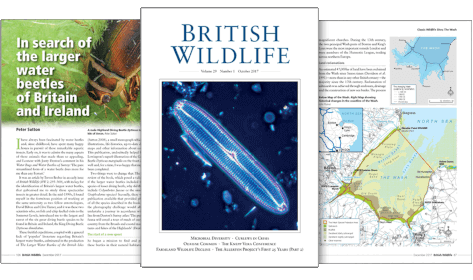
British Wildlife

8 issues per year 84 Seiten per Ausgabe Nur im Abonnement erhältlich

British Wildlife is the leading natural history magazine in the UK, providing essential reading for both enthusiast and professional naturalists and wildlife conservationists. Published eight times a year, British Wildlife bridges the gap between popular writing and scientific literature through a combination of long-form articles, regular columns and reports, book reviews and letters.

Abonnement ab £33 im Jahr

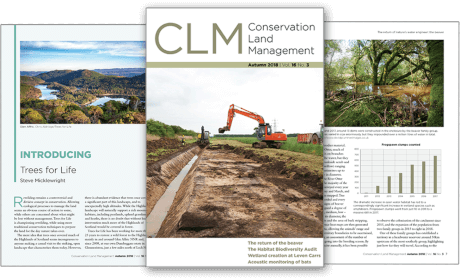
Conservation Land Management

4 Auflagen im Jahr 44 Seiten Nur im Abonnement erhältlich

Conservation Land Management (CLM) ist ein Mitgliedermagazin und erscheint viermal im Jahr. Das Magazin gilt allgemein als unverzichtbare Lektüre für alle Personen, die sich aktiv für das Landmanagement in Großbritannien einsetzen. CLM enthält Artikel in Langform, Veranstaltungslisten, Buchempfehlungen, neue Produktinformationen und Berichte über Konferenzen und Vorträge.

Subscriptions from £26 per year
Akademische und professionelle Bücher  Reference  Data Analysis & Modelling  Study Design, Monitoring & Sampling

Research Methods for the Biosciences

Handbook / Manual
By: Debbie Holmes(Author), Peter Moody(Author), Diana Dine(Author), Laurence Trueman(Author)
460 pages, 93 two-tone and b/w illustrations, two-tone tables
Research Methods for the Biosciences
Click to have a closer look
  • Research Methods for the Biosciences ISBN: 9780198728498 Edition: 3 Paperback Nov 2016 Not in stock: Usually dispatched within 6 days
    £55.99
    #228765
Price: £55.99
About this book Contents Customer reviews Biography Related titles

About this book

Scientific research is a proven and powerful tool for discovering the answers to biological questions. As such, today's students need to be well-versed in experimental design, analysis, and the communication of research. Furthermore, they must appreciate how all of these aspects are interlinked – how, for example, statistics can be used to inform the design of a particular experiment. As a resource which skillfully integrates all of the key aspects relating to biological research, Research Methods for the Biosciences is the perfect guide for undergraduates.

The exceptionally clear layout takes students through choosing a project and planning their research; collecting, evaluating, and analysing their data; and finally reporting their results. Research methods, which can often seem abstract, are brought to life through the use of examples taken from real undergraduate research. Friendly guidance and advice is provided throughout the text, and little prior knowledge or mathematical experience is required. Since statistics is a subject best learned through doing, frequent worked examples appear throughout Part Two 'Handling your data', showing step-by-step how to carry out the various statistical tests. In addition, online software walkthroughs and video screencasts clearly demonstrate how to use software such as SPSS, Minitab, Excel and R to carry out statistical analyses.

Contents

Planning your experiment
1. Where do I begin?
2. Planning your experiment
3. Questionnaires, focus groups, and interviews
4. Research, the law, and you

Handling your data
5. What to do with raw data
6. An introduction to hypothesis testing
7. Which statistical test should I choose?
8. Hypothesis testing: do my data fit an expected ratio?
9. Hypothesis testing: associations and relationships
10. Hypothesis testing: do my samples come from the same population? Parametric data
11. Hypothesis testing: do my samples come from the same population? Non-parametric data

Reporting your results
12. Reporting your research

Customer Reviews

Biography

Debbie Holmes, Diana Dine, Peter Moody, and Laurence Trueman are all senior lecturers in the Department of Applied Sciences, Geography and Archaeology at the University of Worcester. Between them, the authors have wide experience of teaching across a broad range of biological and environmental science-based subject areas, and developing web-based resources to support their undergraduate teaching.

Handbook / Manual
By: Debbie Holmes(Author), Peter Moody(Author), Diana Dine(Author), Laurence Trueman(Author)
460 pages, 93 two-tone and b/w illustrations, two-tone tables
Media reviews

Review of the first edition:

"Well-organised and easy to read, Research Methods for the Biosciences is a useful tool for undergraduates, not to mention those involved in teaching in this field."
– David Sotres, Good Clinical Practice Journal, August 2006

Current promotions
Great GiftsNew and Forthcoming BooksBritish Wildlife Magazine SubscriptionField Guide Sale 2025