Um genaue Preise zu sehen, wählen Sie bitte Ihr Lieferland.
 
 
United States
£ GBP
Alle Kategorien
Important Notice for US Customers

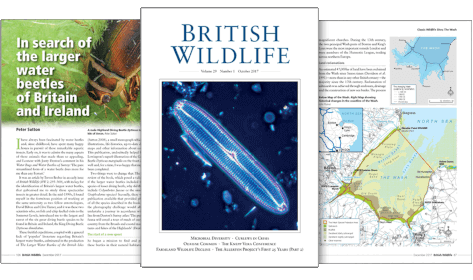
British Wildlife

8 issues per year 84 Seiten per Ausgabe Nur im Abonnement erhältlich

British Wildlife is the leading natural history magazine in the UK, providing essential reading for both enthusiast and professional naturalists and wildlife conservationists. Published eight times a year, British Wildlife bridges the gap between popular writing and scientific literature through a combination of long-form articles, regular columns and reports, book reviews and letters.

Abonnement ab £33 im Jahr

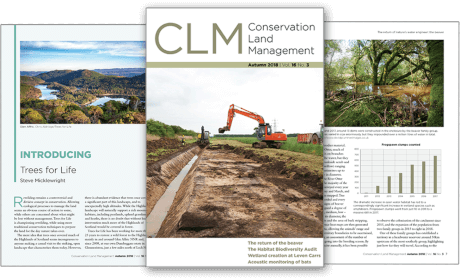
Conservation Land Management

4 Auflagen im Jahr 44 Seiten Nur im Abonnement erhältlich

Conservation Land Management (CLM) ist ein Mitgliedermagazin und erscheint viermal im Jahr. Das Magazin gilt allgemein als unverzichtbare Lektüre für alle Personen, die sich aktiv für das Landmanagement in Großbritannien einsetzen. CLM enthält Artikel in Langform, Veranstaltungslisten, Buchempfehlungen, neue Produktinformationen und Berichte über Konferenzen und Vorträge.

Subscriptions from £26 per year
Akademische und professionelle Bücher  Natural History  General Natural History

The Agricultural Revolution in South Lincolnshire

By: David Grigg
236 pages
The Agricultural Revolution in South Lincolnshire
Click to have a closer look
  • The Agricultural Revolution in South Lincolnshire ISBN: 9780521106153 Paperback Apr 2009 Expected delivery 16th January - 19th January
    £32.00
    #180750 | Stock: 0
Price: £32.00
About this book Contents Customer reviews Related titles

About this book

The new farming methods that so radically changed English agriculture in the eighteenth and early nineteenth centuries were not adopted immediately by all farmers. The rate of improvement was uneven, not only between one farmer and another, but between different farming regions.

This book suggests an approach to the problem of regional agricultural change and the factors which determined the different rates of change. Dr Grigg begins by describing the differences between the agricultural regions of South Lincolnshire - that is the two parts of Kesteven and Holland, an area fairly typical of eastern England - at the end of the eighteenth century. These were differences not only of land use and soil type but of landownership and farm size, productivity and location. The diffusion and adoption of new methods in each region is considered against the general economic background of the late eighteenth century and the boom conditions of the period of the Napoleonic Wars.

The later part of the book traces the rate of farming improvement in the less favourable price conditions after 1815, and finds a marked contrast between this period and the preceding forty years.The way in which the agricultural geography of the area was changed by the new methods is discussed, and in addition Dr Grigg shows how the conditions of each agricultural region affected farmers' response to the new methods.

Contents

Part I. Agriculture During the Napoleonic Wars:
1. The Land;
2. Prices and Progress;
3. Farming Methods and Productivity;
4. The Patterns of Land Use;
5. Landlords, Farmers and Farms;
6. The Agricultural Regions;

Part II. Agriculture After 1815:
7. Paradox and Progress;
8. The Age of Improvement;
9. The New Agricultural Geography;
10. The Changing Regional Pattern;
11. Some Conclusions.

Customer Reviews

By: David Grigg
236 pages
Current promotions
January SaleNew and Forthcoming BooksBritish Wildlife Magazine SubscriptionField Guide Sale 2025