Um genaue Preise zu sehen, wählen Sie bitte Ihr Lieferland.
 
 
United States
£ GBP
Alle Kategorien
Important Notice for US Customers

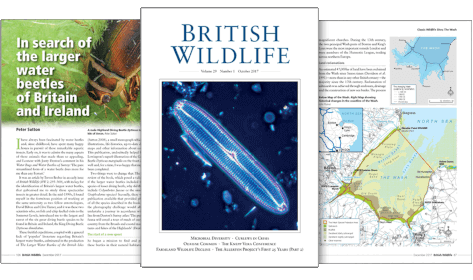
British Wildlife

8 issues per year 84 Seiten per Ausgabe Nur im Abonnement erhältlich

British Wildlife is the leading natural history magazine in the UK, providing essential reading for both enthusiast and professional naturalists and wildlife conservationists. Published eight times a year, British Wildlife bridges the gap between popular writing and scientific literature through a combination of long-form articles, regular columns and reports, book reviews and letters.

Abonnement ab £33 im Jahr

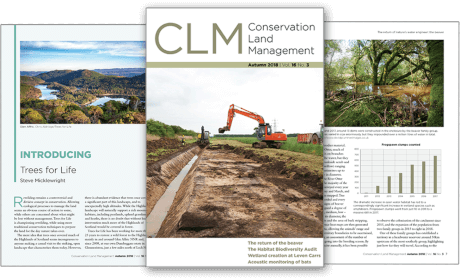
Conservation Land Management

4 Auflagen im Jahr 44 Seiten Nur im Abonnement erhältlich

Conservation Land Management (CLM) ist ein Mitgliedermagazin und erscheint viermal im Jahr. Das Magazin gilt allgemein als unverzichtbare Lektüre für alle Personen, die sich aktiv für das Landmanagement in Großbritannien einsetzen. CLM enthält Artikel in Langform, Veranstaltungslisten, Buchempfehlungen, neue Produktinformationen und Berichte über Konferenzen und Vorträge.

Subscriptions from £26 per year
Akademische und professionelle Bücher  History & Other Humanities  History of Science & Nature

The Traveling Anatomist Nicolaus Steno and the Intersection of Disciplines in Early Modern Science

New
By: Nuno Castel-Branco(Author)
320 pages, 40 b/w illustrations, 1 table
The Traveling Anatomist
Click to have a closer look
Select version
  • The Traveling Anatomist ISBN: 9780226842295 Paperback Oct 2025 Not in stock: Usually dispatched within 1 week
    £28.00
    #267836
  • The Traveling Anatomist ISBN: 9780226842271 Hardback Oct 2025 Not in stock: Usually dispatched within 1 week
    £92.00
    #267835
Selected version: £28.00
About this book Contents Customer reviews Biography Related titles

About this book

Reevaluates Nicolaus Steno's contributions to anatomy and early modern science, examining his interdisciplinary interests in their historical context.

Nicolaus Steno (1638-1686) was a renowned anatomist in his lifetime. He reformed the anatomical understanding of glands, argued that the heart was a muscle, renamed the so-called female testicles as ovaries, and developed a mathematical model for understanding muscle contraction – discoveries that were fundamental to the fields of anatomy and physiology. However, other aspects of Steno's life have come to define him: his claim that mountains' strata reveal the history of the Earth and his conversion to Catholicism as a practising scientist. This excessive attention to his geological discoveries and to asking whether science and religion are compatible, Nuno Castel-Branco argues, has obscured his significant accomplishments as an anatomist. The Traveling Anatomist thus restores Steno to his rightful place as a crucial figure in early modern science.

Using Steno's extensive travels as a framework, The Traveling Anatomist depicts him as an active participant in the Republic of Letters. Castel-Branco traverses Leiden, Paris, Copenhagen, Florence, and Rome as he follows Steno in his sojourns through different scientific academies, courts, and artisanal workshops. There, he developed new friends, some of whom were women, with whom he researched and exchanged ideas. Drawing on Steno's books, correspondence, and novel archival material, Castel-Branco invites us to approach Steno and his accomplishments in anatomy, mathematics, and geology through the eyes of his contemporaries. Doing so, Castel-Branco reconstructs the rich and overlapping worlds of scientific disciplines that shaped Steno's work, revealing the richness of interdisciplinary research in early modern intellectual life. And through Steno, he illustrates larger developments and new networks of significance in mid-seventeenth-century science. By focusing on ideas, scientific genres, institutions, and friendships, Castel-Branco offers a way others might also productively study science from the early modern period until today.

Contents

List of Figures and Tables

Introduction. The Various Travels of Nicolaus Steno
- The Worlds of Traveling Scholars
- The Intersection of Disciplines
- Mathematizing the Body
- Across the Roads of Europe

One. The Uses of Chaos; or, What Did Nicolaus Steno Know?
- The Cathedral School, Mathematics, and Goldsmithing
- Travels, Note-Taking, and the Making of "Chaos"
- A Pious Search for Certainty and Focus
- Post-Harveian Anatomy at the Center
- Learning Interdisciplinary Methods

Two. The Making of a Scholarly Anatomist
- Authorship and the Blasius Controversy
- The Historia of the Glands
- "The Pen Following the Knife": The Making of a Scholar

Three. Dissecting with Numbers, Machines, and Mixtures
- The Mathematics and Mechanics of Glands and Muscles
- The (Non-Cartesian) Epistemology of Nicolaus Steno
- Observations in Practice: The Lymphatics Controversy
- Galen, God, and Gassendi
- The Mechanical and Chymical Worlds of the Netherlands

Four. In the Cradle of the Academie des Sciences
- Monsieur Stenon, a Scavant Danois in Paris
- The Academie de Physique de Caen
- Breathing Physico-Mathematics: The Friendship Between Steno and Swammerdam
- The Benefits of Being Anti-Cartesian

Five. Anatomy and Mathematics at the Medici Court
- Travels Across the Networks of Florence
- The First Italian Month: Dissecting and Searching for Certainty
- Mathematics Mattered in Rome
- Intersecting Muscles with Mathematics in Florence
- Friendships, Patronage, and the Accademia del Cimento

Six. Thinking the Earth with the Body
- The Delayed Manuscript
- Comparisons in Anatomy
- Comparisons in Earth History
- The Search for Certainty in Anatomy
- Models in Anatomy
- The Search for Certainty in Earth History
- Models in Earth History

Seven. Anatomy of a Conversion
- Religious Conversions in Seventeenth-Century Europe
- Friendships, from Collaboration to Conversion
- The Search for Certainty in Religion
- Steno and the Devout Women

Epilogue

Acknowledgments
Bibliography
Index

Customer Reviews

Biography

Nuno Castel-Branco is a research fellow of All Souls College at the University of Oxford.

New
By: Nuno Castel-Branco(Author)
320 pages, 40 b/w illustrations, 1 table
Media reviews

"A marvelously detailed account of the life and thought of Steno, one of the most significant but least-known figures of the seventeenth century, who used mathematics to understand muscles, made the first geological investigation of fossils, and convinced people that women have eggs. Deploying novel archival sources and taking us through a close reading of Steno's life and times, Castel-Branco explores Steno's place in the rich mosaic of European ideas, showing how he grappled with the power of anatomy and mathematics and their interaction with the pull of religion. Highly recommended!" -- Matthew Cobb, author of "As Gods: A Moral History of the Genetic Age"
"In this deeply researched book, we follow the young Steno through the courts, academies, and salons of Europe during the golden age of the new science. Castel-Branco offers a vivid tapestry of people, places, and things that conveys the excitement and complexity of this era." -- Anita Guerrini, author of "Experimenting with Humans and Animals: From Aristotle to CRISPR"

Current promotions
Great GiftsNew and Forthcoming BooksBritish Wildlife Magazine SubscriptionField Guide Sale 2025