Um genaue Preise zu sehen, wählen Sie bitte Ihr Lieferland.
 
 
United States
£ GBP
Alle Kategorien
Important Notice for US Customers

British Wildlife

8 issues per year 84 Seiten per Ausgabe Nur im Abonnement erhältlich

British Wildlife is the leading natural history magazine in the UK, providing essential reading for both enthusiast and professional naturalists and wildlife conservationists. Published eight times a year, British Wildlife bridges the gap between popular writing and scientific literature through a combination of long-form articles, regular columns and reports, book reviews and letters.

Abonnement ab £33 im Jahr

Conservation Land Management

4 Auflagen im Jahr 44 Seiten Nur im Abonnement erhältlich

Conservation Land Management (CLM) ist ein Mitgliedermagazin und erscheint viermal im Jahr. Das Magazin gilt allgemein als unverzichtbare Lektüre für alle Personen, die sich aktiv für das Landmanagement in Großbritannien einsetzen. CLM enthält Artikel in Langform, Veranstaltungslisten, Buchempfehlungen, neue Produktinformationen und Berichte über Konferenzen und Vorträge.

Subscriptions from £26 per year
Akademische und professionelle Bücher  Natural History  General Natural History

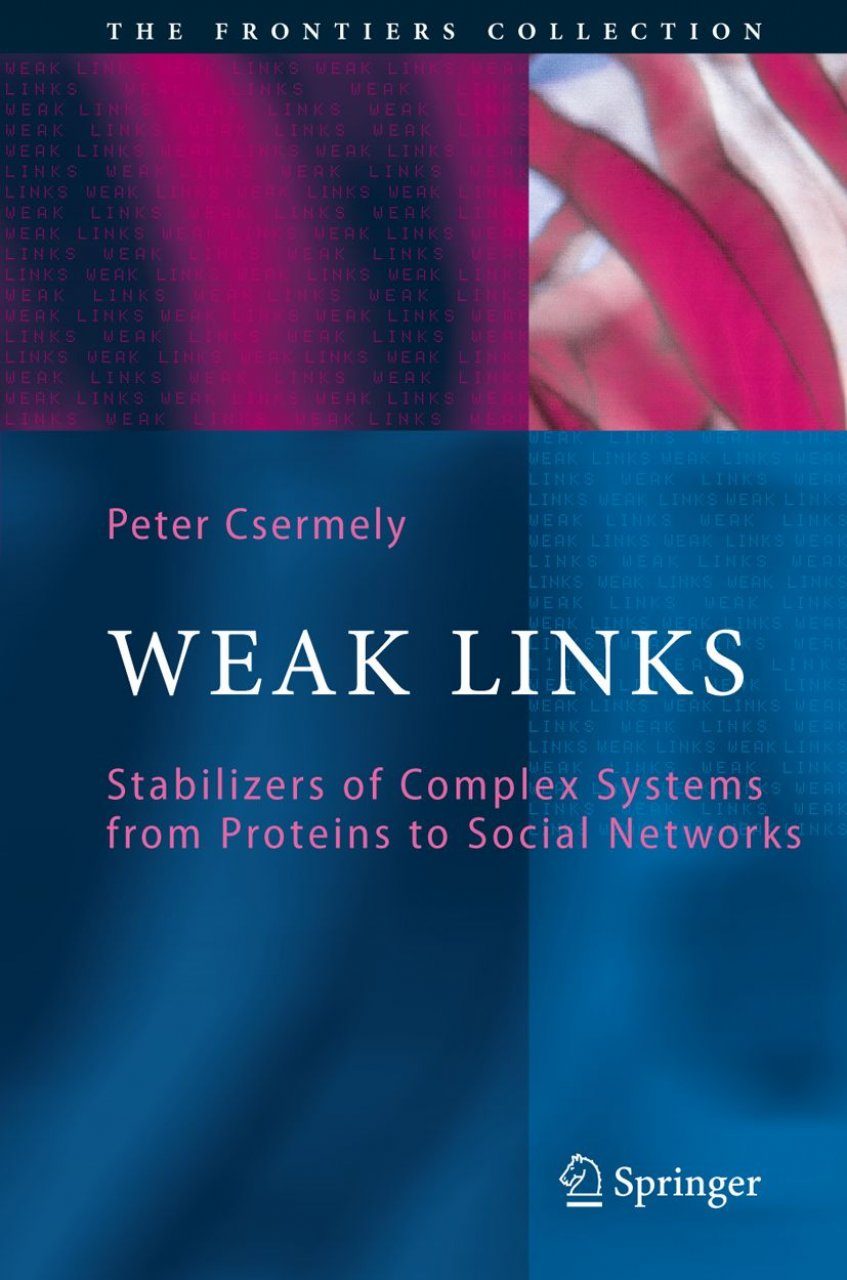
Weak Links Stabilizers of Complex Systems from Proteins to Social Networks

By: Peter Csermely
392 pages, 52 illus
Publisher: Springer Nature
Weak Links
Click to have a closer look
Select version
  • Weak Links ISBN: 9783642011924 Paperback Jun 2009 Not in stock: Usually dispatched within 1-2 weeks
    £44.99
    #181863
  • Weak Links ISBN: 9783540311515 Hardback Mar 2006 Not in stock: Usually dispatched within 1-2 weeks
    £44.99
    #161464
Selected version: £44.99
About this book Contents Customer reviews Biography Related titles

About this book

Why do women stabilize our societies? Why can we enjoy and understand Shakespeare? Why are fruitflies uniform? Why do omnivorous eating habits aid our survival? Why is Mona Lisa's smile beautiful? This book shows that the statement "weak links stabilize complex systems" holds the answers to all these surprising questions, and many more. The author, a recipient of several distinguished science communication prizes, explains weak or low probability interactions, and uses them as connecting threads in a vast variety of networks from proteins to ecosystems. This unique book and the ideas it develops will have a significant impact on diverse, seemingly unrelated fields of study.

Contents

Introduction: How the Links Were Formed.- A Principle is Born: The Granovetter-Study.- Why do we Like Networks?.- Network Stability.- Weak Links as Stabilizers of Complex Systems.- Atoms, Molecules, Macromolecules.- Weak Links and Cellular Stability.- Weak Links and the Stability of Organisms.- Social Nets.- Networks of Human Culture.- The Global-Web.- The Eco-Web.- Conclusions and Perspectives.

Customer Reviews

Biography

Peter Csermely (50) is a professor at the Semmelweis University in Budapest. A former Fogarty Fellow at Harvard University, his main fields of study are molecular chaperones and networks. In 1996 Dr. Csermely launched a highly successful initiative providing research opportunities for more than 10,000 gifted high school students. He also established the Hungarian National Talent Support Council and the Network of Youth Excellence, www.nyex.info, promoting similar activities in 33 countries. He has published 11 books and more than 200 research papers. Dr. Csermely holds several distinguished appointments including membership of the Wise Persons' Council of the Hungarian President, vice-president of the Hungarian Biochemical Society and has been recipient of numerous international fellowships and awards, for example the 2003 Science Communication Award of the European Molecular Biology Organization and the 2004 Descartes Award of the European Union for Science Communication.

By: Peter Csermely
392 pages, 52 illus
Publisher: Springer Nature
Media reviews

Opinions "This is an excellent book, which shows the far-reaching consequences of the great variety of weak links. The book has a proper balance between a scientific monograph and a popular approach, and mixes humor with sharp intellect. "Weak Links" is an adventurous, entertainingly eclectic and rich work both for the experts and laymen." (Laszlo-Albert Barabasi, Department of Physics, University of Notre Dame, author of the bestseller book, Linked and the 1999 seminal Science paper on the preferential attachment model of scale-free network topology.) "You have written a very personal, engaging, and unique book that will appeal to readers and get them thinking." (Steve Strogatz, Dept. of Theoretical and Applied Mathematics, Cornell University, author of Sync and the 1998 seminal Nature paper on small worlds.) "You have done a great service by making the world of networks understandable and clear. I will use your book in my classes." (Caroline S. Wagner, Center of International Science & Technology Policy, George Washington University, author of several science policy-related books including the an upcoming work on the international collaboration in science) "This book links an exceptionally large number of areas and gives exciting novel information to both the network experts and the science-orinted general readership." (Tamas Vicsek, Dept. Biological Physics, Eotvos University, author of several network-related Nature papers including a method to determine overlapping network modules) "This masterpiece should serve as an example how science can be discussed. Entertaining yet thought provoking." (Gyorgy Buzsaki, Board of Governors Professor, Center for Molecular and Behavioral Neuroscience Rutgers University, a leading expert of neuronal networks) "You have written a true gem of a book; erudite, humane, funny, accessible and thoroughly fascinating. On every page, I find another delight that makes me smile and leads me down new intellectual paths (weak links again!). Thanks to your thorough footnotes, I can delve as deep as I would like into the professional papers. Outstanding - I wish more books were written this way. I have adopted your book as a textbook for my Science of Networks class, and I will recommend it to anyone who ask without hesitation. You did a great service to pedagogy and to this budding science with this magisterial survey. I really appreciate it and my students will, as well." (Daniel J. Bilar, Computer Science Department, Wellesley College MA, USA) Aus den Rezensionen: "! eine Buchreihe ... Begrundet und redaktionell betreut von Physikerin Angela Lahee, hat sie das Ziel, den Lesern eine Erweiterung und Reflexion der eigenen Wissensgrenzen zu ermoglichen. ! Eine hochinteressante transdisziplinare Analyse komplexer Systeme ! Ungewohnlich fur ein Wissenschaftsbuch ! zu der gut verstandlichen, ja unterhaltsamen Darstellung passend, sind die vielen h

Current promotions
Great GiftsNew and Forthcoming BooksBritish Wildlife Magazine SubscriptionField Guide Sale 2025