Um genaue Preise zu sehen, wählen Sie bitte Ihr Lieferland.
 
 
United States
£ GBP
Alle Kategorien
Important Notice for US Customers

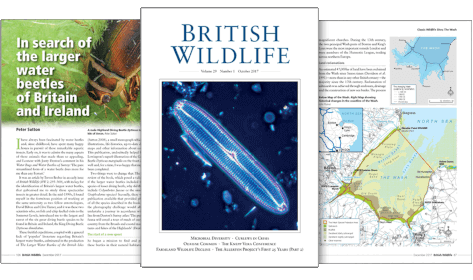
British Wildlife

8 issues per year 84 Seiten per Ausgabe Nur im Abonnement erhältlich

British Wildlife is the leading natural history magazine in the UK, providing essential reading for both enthusiast and professional naturalists and wildlife conservationists. Published eight times a year, British Wildlife bridges the gap between popular writing and scientific literature through a combination of long-form articles, regular columns and reports, book reviews and letters.

Abonnement ab £33 im Jahr

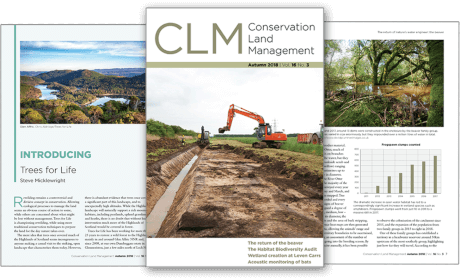
Conservation Land Management

4 Auflagen im Jahr 44 Seiten Nur im Abonnement erhältlich

Conservation Land Management (CLM) ist ein Mitgliedermagazin und erscheint viermal im Jahr. Das Magazin gilt allgemein als unverzichtbare Lektüre für alle Personen, die sich aktiv für das Landmanagement in Großbritannien einsetzen. CLM enthält Artikel in Langform, Veranstaltungslisten, Buchempfehlungen, neue Produktinformationen und Berichte über Konferenzen und Vorträge.

Subscriptions from £26 per year
Akademische und professionelle Bücher  Insects & other Invertebrates  Insects  Bees, Ants & Wasps (Hymenoptera)

In Silico Bees

By: James Devillers(Author)
480 pages, 11 colour & 88 b/w illustrations, 17 tables
Publisher: CRC Press
In Silico Bees
Click to have a closer look
Select version
  • In Silico Bees ISBN: 9781138374706 Paperback Nov 2018 Not in stock: Usually dispatched within 1 week
    £61.99
    #246352
  • In Silico Bees ISBN: 9781466517875 Hardback Jan 2014 Out of stock with supplier: order now to get this when available
    £175.00
    #206383
Selected version: £61.99
About this book Contents Customer reviews Biography Related titles

About this book

Bees are critically important for ecosystem function and biodiversity maintenance through their pollinating activity. Unfortunately, bee populations are faced with many threats, and evidence of a massive global pollination crisis is steadily growing. As a result, there is a need to understand and, ideally, predict how bees respond to pollution disturbance, to the changes over landscape gradients, and how their responses can vary in different habitats, which are influenced to different degrees by human activities.

Modeling approaches are useful to simulate the behavior of whole population dynamics as well as to focus on important phenomena detrimental to bee-life history traits. They also allow simulation of how a disease or a pesticide can impact the survival and growth of a bee population. In Silico Bees provides a collection of computational methods to those primarily interested in the study of the ecology, ethology, and ecotoxicology of bees. The book presents different cases studies to enable readers to understand the significance and also the limitations of models in theoretical and applied bee research.

The text covers modeling of honey bee society organization, infectious diseases in colonies, pesticide toxicity, chemical contamination of the hive, and more. Written by an international team of scientists, In Silico Bees is of primary interest to those whose research or professional activity is directly concerned with the study of bees. It is also intended to provide graduate and post-graduate students with a clear and accessible text covering the main types of modeling approaches that can be used in terrestrial ecology and ecotoxicology.

Contents

Automatic Systems for Capturing the Normal and Abnormal Behaviors of Honey Bees
      James Devillers and Hugo Devillers
Computational Modeling of Organization in Honey Bee Societies Based on Adaptive Role Allocation
      Mark Hoogendoorn, Martijn C. Schut, and Jan Treur
Illustrating the Contrasting Roles of Self-Organization in Biological Systems with Two Case Histories of Collective Decision Making in the Honey Bee
      Brian R. Johnson
Models for the Recruitment and Allocation of Honey Bee Foragers
      Mary R. Myerscough, James R. Edwards, and Timothy M. Schaerf
Infectious Disease Modeling for Honey Bee Colonies
      Hermann J. Eberl, Peter G. Kevan, and Vardayani Ratti
Honeybee Ecology from an Urban Landscape Perspective: The Spatial Ecology of Feral Honey Bees
      Kristen A. Baum, Maria D. Tchakerian, Andrew G. Birt, and Robert N. Coulson
QSAR Modeling of Pesticide Toxicity to Bees
      James Devillers
Mathematical Models for the Comprehension of Chemical Contamination into the Hive
      Paolo Tremolada and Marco Vighi
Agent-Based Modeling of the Long-Term Effects of Pyriproxyfen on Honey Bee Population
      James Devillers, Hugo Devillers, Axel Decourtye, Julie Fourrier, Pierrick Aupinel, and Dominique Fortini
Simulation of Solitary (non-Apis) Bees Competing for Pollen
      Jeroen Everaars and Carsten F. Dormann
Estimating the Potential Range Expansion and Environmental Impact of the Invasive Bee-Hawking Hornet, Vespa velutina nigrithorax
      Claire Villemant, Franck Muller, Quentin Rome, Adrien Perrard, Morgane Barbet-Massin, and Frédéric Jiguet

Customer Reviews

Biography

James Devillers has authored/edited 15 books and published more than 200 peer-reviewed papers and book chapters in QSAR and (eco)toxicology modeling. He is editor-in-chief of the journal SAR and QSAR in Environmental Research (Taylor & Francis) and editor of the series of books QSAR in Environmental and Health Sciences (CRC Press). James Devillers is also a member of the editorial boards of Ecological Modelling (Elsevier), Xenobiotica (Taylor & Francis), Current Bioactive Compounds (Bentham Science), and Toxics (MDPI AG).

By: James Devillers(Author)
480 pages, 11 colour & 88 b/w illustrations, 17 tables
Publisher: CRC Press
Current promotions
January SaleNew and Forthcoming BooksBritish Wildlife Magazine SubscriptionField Guide Sale 2025