To see accurate pricing, please choose your delivery country.
 
 
United States
£ GBP
All Shops
Important Notice for US Customers

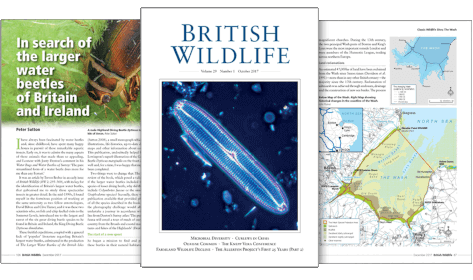
British Wildlife

8 issues per year 84 pages per issue Subscription only

British Wildlife is the leading natural history magazine in the UK, providing essential reading for both enthusiast and professional naturalists and wildlife conservationists. Published eight times a year, British Wildlife bridges the gap between popular writing and scientific literature through a combination of long-form articles, regular columns and reports, book reviews and letters.

Subscriptions from £33 per year

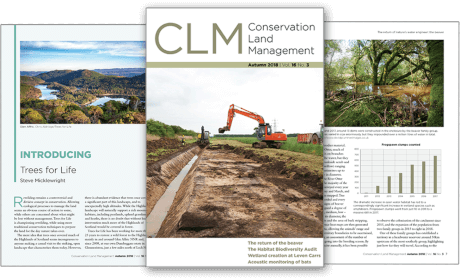
Conservation Land Management

4 issues per year 44 pages per issue Subscription only

Conservation Land Management (CLM) is a quarterly magazine that is widely regarded as essential reading for all who are involved in land management for nature conservation, across the British Isles. CLM includes long-form articles, events listings, publication reviews, new product information and updates, reports of conferences and letters.

Subscriptions from £26 per year
Academic & Professional Books  Reference  Data Analysis & Modelling  Cartography, Remote Sensing, Image Analysis & GIS

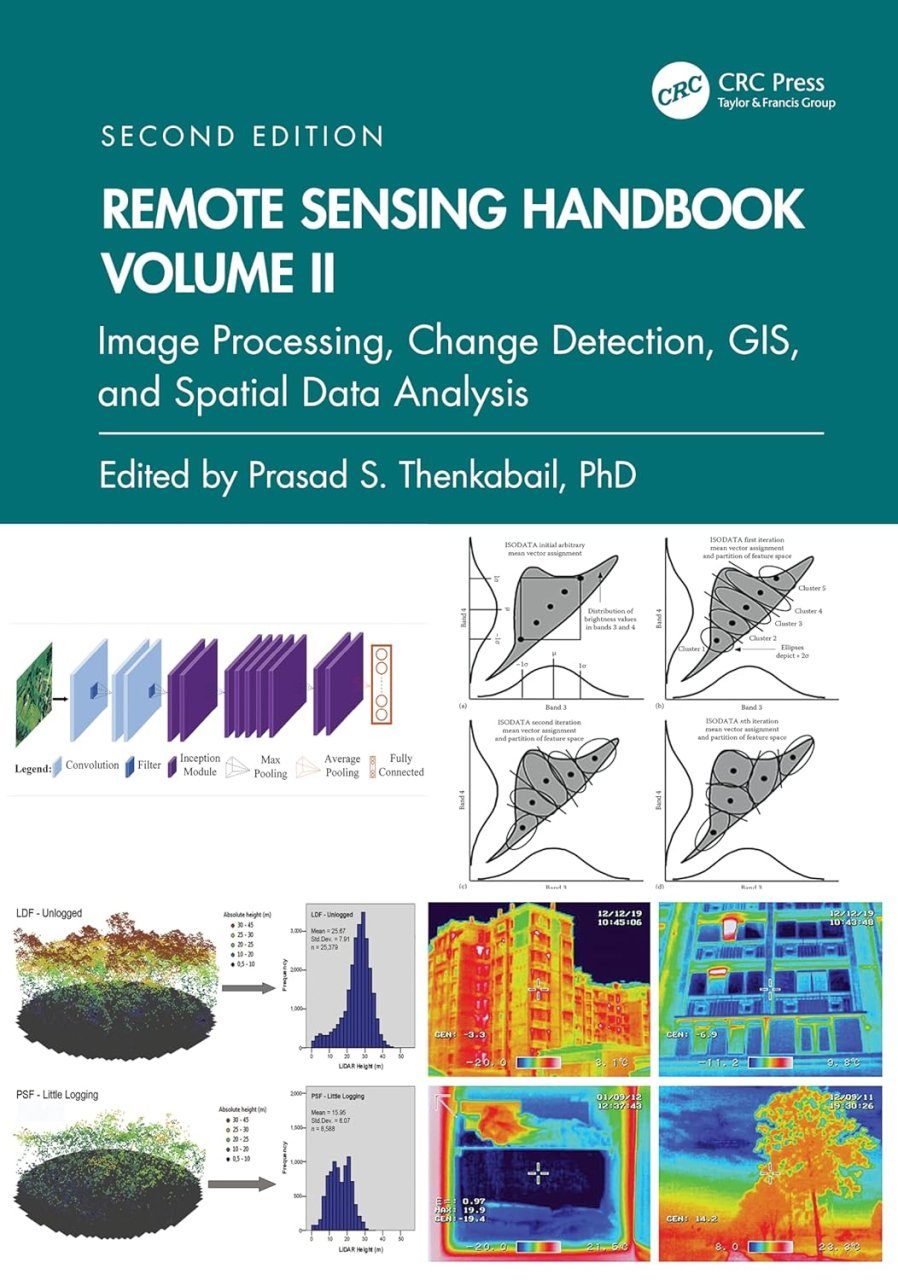
Remote Sensing Handbook, Volume 2 Image Processing, Change Detection, GIS, and Spatial Data Analysis

Series: Remote Sensing Handbook Volume: 2
By: Prasad Srinivasa Thenkabail(Editor)
464 pages, 67 colour & 6 b/w photos, 114 colour & 29 b/w illustrations, 44 tables
Publisher: CRC Press
Remote Sensing Handbook, Volume 2
Click to have a closer look
  • Remote Sensing Handbook, Volume 2 ISBN: 9781032890975 Edition: 2 Hardback Nov 2024 Not in stock: Usually dispatched within 1 week
    £150.00
    #269794
Price: £150.00
About this book Contents Customer reviews Biography Related titles

About this book

Volume 2 of the six-volume Remote Sensing Handbook, second edition, is focused on digital image processing, including image classification methods in land cover and land use. It discusses object-based segmentation and pixel-based image processing algorithms, change detection techniques, and image classification for a wide array of applications, including land use/land cover, croplands, urban studies, processing hyperspectral remote sensing data, thermal imagery, light detection and ranging (LiDAR), geoprocessing workflows, frontiers of GIScience, and future pathways. This thoroughly revised and updated volume draws on the expertise of a diverse array of leading international authorities in remote sensing and provides an essential resource for researchers at all levels interested in using remote sensing. It integrates discussions of remote sensing principles, data, methods, development, applications, and scientific and social context.

Features
- Provides the most up-to-date comprehensive coverage of digital image processing.
- Highlights object-based image analysis (OBIA) and pixel-based classification methods and techniques of digital image processing.
- Demonstrates practical examples of image processing for a myriad of applications such as land use/land cover, croplands, and urban.
- Establishes image processing using different types of remote sensing data that includes multispectral, radar, LiDAR, thermal, and hyperspectral.
- Highlights change detection, geoprocessing, and GIScience.

This volume is an excellent resource for the entire remote sensing and GIS community. Academics, researchers, undergraduate and graduate students, as well as practitioners, decision makers, and policymakers, will benefit from the expertise of the professionals featured in this book, and their extensive knowledge of new and emerging trends.

Contents

Part I: Image Processing Methods and Approaches

1. Digital Image Processing: A Review of the Fundamental Methods and Techniques / Sunil Narumalani and Paul Merani
2. Image Classification Methods in Land Cover and Land Use and Cropland Studies / Mutlu Ozdogan
3. Urban Image Classification: Per-pixel Classifiers, Sub-pixel Analysis, Object-based Image Analysis, and Geospatial Methods / Soe W. Myint, Victor Mesev, Dale Quattrochi, et al.
4. Hyperspectral Image Processing: Methods and Approaches / Jun Li and Antonio Plaza
5. Collaborative Representation for Hyperspectral Image Classification and Detection / Qian Du, Chiranjibi Shah, Hongjun Su, et al. 
6. Thermal Infrared Remote Sensing: Principles and Theoretical Background / Claudia Kuenzer, Philipp Reiners, Jianzhong Zhang,et al. 
7. Remote Sensing Image Segmentation: Methods, Approaches, and Advances / Mohammad D. Hossain and Dongmei Chen
8. Object Based Image Analysis: Evolution, History, State-of-the-Art and Future Vision / Thomas Blaschke, Maggi Kelly, and Helena Merschdorf
9. Geospatial Data Integration in OBIA- implications of Accuracy and Validity / Stefan Lang and Dirk Tiede
10. Image Segmentation Algorithms for Land Categorization / James C. Tilton, Selim Aksoy, and Yuliya Tarabalka
11. LiDAR Data Processing and Applications / Shih-Hong Chio, Tzu-Yi Chuang, Pai-Hui Hsu,et al. 

Part II: Change Detection
12. Forest Clear-Cutting Detection in Subtropical Regions with Time Series Remotely Sensed Data / Guiying Li, Mingxing Zhou, Ming Zhang, et al.

Part III: Integrating Geographic Information Systems (GIS) and Remote Sensing in Spatial Modeling Framework for Decision Support
13. Geoprocessing, Workflows, and Provenance / Jason A. Tullis, David P. Lanter, Aryabrata Basu, et al. 
14. Toward Democratization of Geographic Information: GIS, Remote Sensing, and GNSS Applications in Everyday Life / Gaurav Sinha, Barry J. Kronenfeld, and Jeffrey C. Brunskill
15. Frontiers of GIScience: Evolution, State-of-Art, and Future Pathways / May Yuan
16. Object-Based Regionalization for Policy-Oriented Partitioning of Space / Stefan Lang, Stefan Kienberger, Michael Hagenlocher, et al.

Part IV: Summary and Synthesis of Volume 2
17. Remote Sensing Handbook, Volume II: Image Processing, Change Detection, GIS and Spatial Data Analysis / Prasad Thenkabail

Customer Reviews

Biography

Dr Prasad S. Thenkabail, Senior Scientist (ST), United States Geological Survey (USGS), is a world-recognised expert in remote sensing science with major contributions in the field for nearly 40 years. He has made the list of the world's top 1% of scientists across 22 scientific fields and 176 sub-fields. Dr Thenkabail has conducted pioneering research in hyperspectral remote sensing of vegetation, global croplands, and their water use for food security. He obtained his PhD from the Ohio State University in 1992 and has 168 peer-reviewed publications, including 15 books (which includes this six-volume set), and over 15 major data releases such as the Landsat-derived global cropland extent product @ 30m and Landsat-derived rainfed and irrigated cropland area product @ 30 m (LGRIP30). He was recognised as a Fellow of the American Society of Photogrammetry and Remote Sensing (ASPRS) in 2023. His scientific papers have won several awards for demonstrating world-class, highest-quality research. He was a Landsat Science Team Member (2007-2011).

Series: Remote Sensing Handbook Volume: 2
By: Prasad Srinivasa Thenkabail(Editor)
464 pages, 67 colour & 6 b/w photos, 114 colour & 29 b/w illustrations, 44 tables
Publisher: CRC Press
Media reviews

The chapters in Remote Sensing Handbook are written by leading remote sensing scientists of the world and ably edited by Prasad S. Thenkabail, Senior Scientist, at U.S. Geological Survey (USGS) in Flagstaff, Arizona. The importance and the value of the Remote Sensing Handbook is clearly demonstrated by the need for a second edition. The Remote Sensing Handbook (First Edition, Volumes I-III) was published in 2014 and now after 10 years Remote Sensing Handbook, Second Edition, (Volumes I-VI) with 91 Chapters and nearly 3500 pages will be published. It is certainly monumental work in remote sensing science and for this I want to compliment Dr. Prasad Thenkabail. Remote sensing is now important to a large number of scientific disciplines beyond our community, and I recommend the Remote Sensing Handbook, Second Edition, Six Volume Set, to not only remote sensers but to the entire scientific community.

Dr. Compton Jim Tucker, Senior Scientist, Hydrospheric and Biospheric Laboratory, NASA Goddard Space Flight Center (GSFC), USA

It is not often that a Remote Sensing 'Handbook' containing rich and diverse contributions from some of the best researchers worldwide is compiled and published. So please take note that The Remote Sensing Handbook, Second Edition, edited by Dr Prasad S. Thenkabail has landed. This book contains everything you need to know to become a remote sensing scientist. The principles, the different wavelengths, the considerations to take into account for cloud processing, calibration and validation considerations and all the domain application areas you can possibly consider; some of which I was not even aware of, are all in there. Chapters of the book delve into topics such as space law and data for policy applications. Thank you to the authors for their contributions and commitment to ensure that this book becomes a very useful resource for researchers and students as the subject of Remote Sensing moves ahead with great pace into the 2nd quarter of the 21st Century.

Prof. Kevin J. Tansey, Editor-in-Chief, International Journal of Remote Sensing and Professor of Remote Sensing, University of Leicester, UK

This six-volume, Second Edition of the Remote Sensing Handbook provides a collection of chapters covering the gamut of remote sensing topics and applications. The chapters are written by many well-known members of the international remote sensing community, offering diverse perspectives on this rapidly developing discipline. The Handbook will be useful for students and practitioners alike. This compilation is a major undertaking and I congratulate Dr. Prasad Thenkabail on its completion.

Prof. Chris Justice, University of Maryland College Park, USA

Dr. Thenkabail and his colleagues do a brilliant job of condensing nearly 60 years of research and developments in remote sensing into a six-volume compendium. Interested in remote sensing, invest in this handbook!

Dr. Ramakrishna Nemani, Senior Earth scientist with the Advanced Supercomputing division at NASA Ames Research Center (retired), and Chief Developed of NASA Earth Exchange (NEX) platform

The second edition of the Remote Sensing Handbook is an impressive collection of 91 chapters in 6 volumes written by some of the best known and most active remote sensing scientists of our time. It is a vast expansion from its first edition of 3 volumes in 2015 and comprehensively covers all the major fields of remote sensing science, including sensors, image processing, information retrieval and a wide range of applications to ecology, agriculture, forestry, urban environment, water resources, climate change, etc. It allows students, scientists, professionals and practitioners to catch up with the rapid development in remote sensing technology, methodology and applications over the past decade. Dr. Prasad S. Thenkabail, a world-renowned remote sensing scientist, is highly commended for undertaking the daunting task of formulating and editing this large collection as the sole editor-in-chief. His 40-year experience in various remote sensing fields makes him well suited for this task.

Dr. Jing M. Chen, Editors-in-Chief of Remote Sensing of Environment, Professor, CRC, FRSC, University of Toronto, Canada

Current promotions
Great GiftsNew and Forthcoming BooksBritish Wildlife Magazine SubscriptionField Guide Sale 2025