Um genaue Preise zu sehen, wählen Sie bitte Ihr Lieferland.
 
 
United States
£ GBP
Alle Kategorien
Important Notice for US Customers

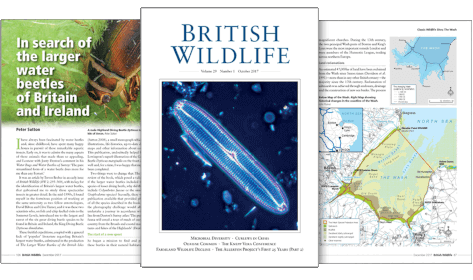
British Wildlife

8 issues per year 84 Seiten per Ausgabe Nur im Abonnement erhältlich

British Wildlife is the leading natural history magazine in the UK, providing essential reading for both enthusiast and professional naturalists and wildlife conservationists. Published eight times a year, British Wildlife bridges the gap between popular writing and scientific literature through a combination of long-form articles, regular columns and reports, book reviews and letters.

Abonnement ab £33 im Jahr

Conservation Land Management

4 Auflagen im Jahr 44 Seiten Nur im Abonnement erhältlich

Conservation Land Management (CLM) ist ein Mitgliedermagazin und erscheint viermal im Jahr. Das Magazin gilt allgemein als unverzichtbare Lektüre für alle Personen, die sich aktiv für das Landmanagement in Großbritannien einsetzen. CLM enthält Artikel in Langform, Veranstaltungslisten, Buchempfehlungen, neue Produktinformationen und Berichte über Konferenzen und Vorträge.

Subscriptions from £26 per year
Akademische und professionelle Bücher  Reference  Physical Sciences  Physics

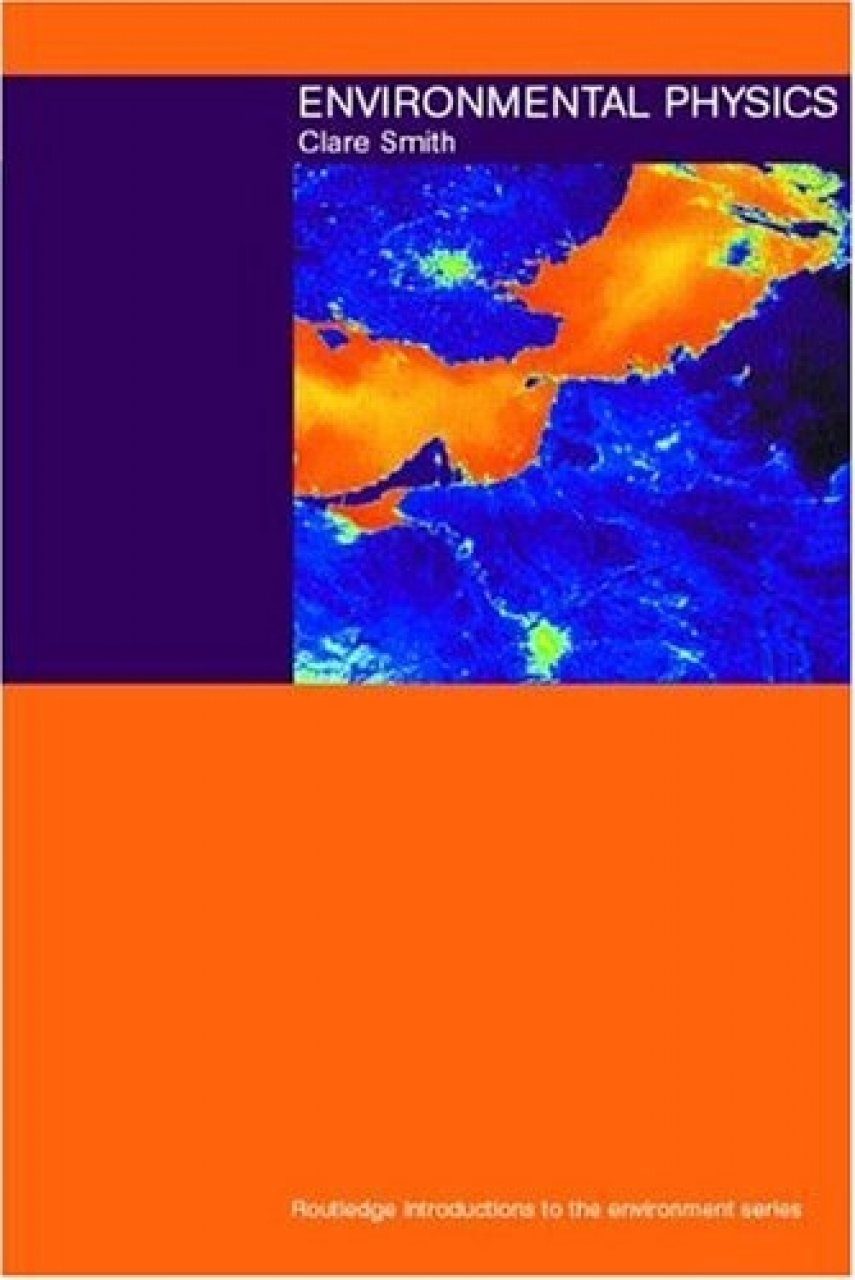
Environmental Physics

Textbook
By: Claire Smith
304 pages, Illus, figs, tabs
Publisher: Routledge
Environmental Physics
Click to have a closer look
Select version
  • Environmental Physics ISBN: 9780415201919 Paperback Jul 2001 Not in stock: Usually dispatched within 1 week
    £41.99
    #119994
  • Environmental Physics ISBN: 9780415201902 Hardback Jul 2001 Not in stock: Usually dispatched within 1 week
    £190.00
    #119992
Selected version: £41.99
About this book Contents Customer reviews Related titles

About this book

Many controversial environmental issues revolve around complex scientific arguments, which can be better understood with a grasp of the key scientific concepts. Environmental Physics provides an introduction to the physical principles that underlie environmental issues and shows how they contribute to the interdisciplinary field of environmental science as a whole. * The forces of nature - Newtonian mechanics, gravity, rotational dynamics and angular momentum, waves and electro-magnetism * Energy - efficiency and entropy, mechanical work, electrical energy, renewable energy, energy use in transport and energy in the biosphere * Heat and Radiation- transmission of heat, engines and thermal power production, radiation, the electromagnetic spectrum and remote sensing * Solids, Liquids and Gases - States of matter, properties of solids, seismic waves, pressure, fluids and fluid flow, hydrology and hydrogeology * The Earths climate and climate change - microclimates, the ozone layer, the 'Greenhouse effect', sea level change and climate modelling Sound and noise - sound waves, noise pollution and control * Radioactivity and nuclear physics - radioactive decay, nuclear fission reactions, radioactive waste disposal, nuclear fusion reactions These fundamental and applied concepts of physics are presented in a simple, easily comprehensible fashion, made relevant by their application to topical environmental issues. Environmental Physics makes the subject accessible to those with little or no previous knowledge of physics. The emphasis is on application rather than theory, so in many cases concepts are described qualitatively rather than quantitatively. As a student of environmental science, the reader will find the wide range of topics covered in a single volume invaluable. Environmental Physics is highly illustrated with over 100 figures and plates, and has boxed case studies, end of chapter summaries, further reading and a glossary.

Contents

Part 1: The Forces of Nature 1.1: Fundamentals: Newtonian Mechanics; 1.2: Gravity; 1.3: Rotational Dynamics and Angular Momentum; 1.4: Waves; 1.5: Electro-magnetism Part 2: Energy 2.1: Energy, Efficiency and Entropy; 2.2: Mechanical Work - Forces and Energy; 2.3: Electrical Energy; 2.4: Renewable Energy; 2.5: Energy Use in Transport; 2.6: Energy in the Biosphere Part 3: Heat and Radiation 3.1: Heat and Temperature; 3.2: Thermal Expansion; 3.3: Transmission of Heat; 3.4: Engines and Thermal Power Production; 3.5: Radiation: The Electromagnetic Spectrum; 3.6: Remote Sensing Part 4: Solids, Liquids and Gases 4.1: Fundamentals: States of Matter; 4.2: Properties of Solids; 4.3: Pressure; 4.4: Gases; 4.5: Fluids and Fluid Flow; 4.6: Hydrology and hydrogeology Part 5: The Earth's Climate and Climate Change 5.1: The Earth's Climate; 5.2: Climate Change Part 6: Sound and Noise 6.1: Sound Waves; 6.2: Noise and Noise Nuisance Part 7: Radioactivity and Nuclear Physics 7.1: Nuclear Physics; 7.2: Biological Impacts of Ionizing Radiation; 7.3: Radioactive Decay; 7.4: Nuclear Fission Reactions; 7.5: Fusion Reactions.

Customer Reviews

Textbook
By: Claire Smith
304 pages, Illus, figs, tabs
Publisher: Routledge
Current promotions
Great GiftsNew and Forthcoming BooksBritish Wildlife Magazine SubscriptionField Guide Sale 2025