To see accurate pricing, please choose your delivery country.
 
 
United States
£ GBP
All Shops
Important Notice for US Customers

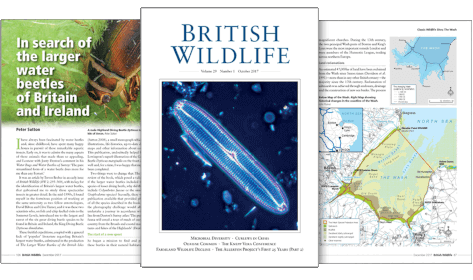
British Wildlife

8 issues per year 84 pages per issue Subscription only

British Wildlife is the leading natural history magazine in the UK, providing essential reading for both enthusiast and professional naturalists and wildlife conservationists. Published eight times a year, British Wildlife bridges the gap between popular writing and scientific literature through a combination of long-form articles, regular columns and reports, book reviews and letters.

Subscriptions from £33 per year

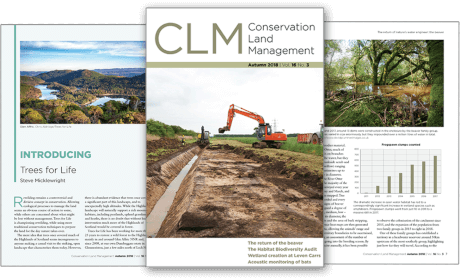
Conservation Land Management

4 issues per year 44 pages per issue Subscription only

Conservation Land Management (CLM) is a quarterly magazine that is widely regarded as essential reading for all who are involved in land management for nature conservation, across the British Isles. CLM includes long-form articles, events listings, publication reviews, new product information and updates, reports of conferences and letters.

Subscriptions from £26 per year
Good Reads  Natural History  General Natural History

Is a River Alive?

Nature Writing Coming Soon
By: Robert Macfarlane(Author)
374 pages, b/w photos, b/w maps
Publisher: Penguin Books
NHBS
Is a River Alive? sees Macfarlane wrestle with this question and examine its relevance to the nascent Rights of Nature movement.
Is a River Alive?
Click to have a closer look
Select version
Average customer review
  • Is a River Alive? ISBN: 9780241624814 Hardback May 2025 In stock
    £19.99 £25.00
    #266161
  • Is a River Alive? ISBN: 9780241998212 Paperback 05 Mar 2026 Available for pre-order
    £11.99
    #269813
Selected version: £19.99
About this book Customer reviews Biography Related titles Recommended titles
Images Additional images
Is a River Alive?

About this book

From celebrated writer Robert Macfarlane comes this brilliant, perspective-shifting new book – which answers a resounding yes to the question of its title.

At its heart is a single, transformative idea: that rivers are not mere matter for human use, but living beings – who should be recognized as such in both imagination and law. Is a River Alive? takes the reader on an exhilarating exploration of the past, present and futures of this ancient, urgent concept.

The book flows first to northern Ecuador, where a miraculous cloud-forest and its rivers are threatened by goldmining. Then, to the wounded rivers, creeks and lagoons of southern India, where a desperate battle to save the lives of these waterbodies is under way. And finally, to north-eastern Quebec, where a spectacular wild river – the Mutehekau or Magpie – is being defended from death by damming in a river-rights campaign. At once Macfarlane's most personal and most political book to date, Is a River Alive? will open hearts, spark debates and lead us to the revelation that our fate flows with that of rivers – and always has.

Customer Reviews (1)

  • A hydrological odyssey
    By Leon (NHBS Catalogue Editor) 4 Jul 2025 Written for Hardback


    Nature writer Robert Macfarlane will need little introduction, having authored a string of successful books on people, landscape, and language. Billed as his most political book to date, Is a River Alive? sees Macfarlane wrestle with the titular question and examine its relevance to the nascent Rights of Nature movement.

    At the heart of this book are three long, 70–100-page parts that detail visits to three river systems in Ecuador, India, and Canada. They are separated by short palate cleansers, describing brief visits to local springs close to his home in Cambridge. In the back, you will find a surprisingly thorough 10-page glossary, notes, a select bibliography, a combined acknowledgements and aftermaths section detailing developments up to publication, and an index.

    This dry enumeration aside, it is the quality of the writing that we are all here for, and Macfarlane is on fine form as he immerses you in the landscapes he visits. These journeys are not solo affairs, however, and in each place he is accompanied by knowledgeable local guides: some are long-term collaborators, others he has only just met. It is a motley crew that includes a mycologist, a musician, and a lawyer, as well as judges, activists, back-country experts, and his close friend Wayne Chambliss. Macfarlane has a knack for giving warm and memorable portraits of them, as well as others they meet along the way.

    The political aspect of this book stems from the fact that all these river systems are under threat; from mining in Ecuador, industrial pollution in India, and the construction of hydroelectric dams in Canada. In part, the book is a reportage on the environmental harm caused by resource extraction, economic development, and heavy industry, and the slow violence it inflicts on predominantly poor and marginalised communities. In Chennai, he graphically details how this has already come to pass, while in Ecuador and Canada, it could come to pass if certain companies were to get their way. In response, Western and Indigenous activists have rallied behind the Rights of Nature movement that originated in 1972 when lawyer Christopher Stone asked whether trees should have standing. Its proponents argue that natural entities such as mountains, forests, and rivers can and should have rights—legal personhood even—and thus protection by law.

    So, is a river alive? What makes this book intriguing and thought-provoking is that Macfarlane does not provide a straightforward answer ("Yes, of course rivers are alive and here is why"). Instead, he wrestles with this question in full view of the reader. Clearly, he supports the environmentalist agenda and quickly counters the claim of anthropomorphism. He refers to rivers as a "who" and not an "it", condemning the habit of the English language to "it" all natural entities, "a mode of address that reduces them to the status of stuff" (p. 22). I like to reference the work of Eileen Crist to make the point that language shapes our reality, and Macfarlane condenses it masterfully here: "Words make worlds" (p. 22).

    Macfarlane's struggle plays out along two axes. First, how can we really speak on nature's behalf? What does a river want? He worries that in granting rights to nature, we will simply end up with "human proxies [...] ventriloquizing 'river' and 'forest' in a kind of cos-play animism" (p. 83). His close friend Wayne justifiably asks whether the whole movement is just "a disguised form of political manoeuvring" (p. 292), in which assigning personhood to natural entities merely becomes a means to an end. Second, there is a philosophical and linguistic struggle. What words can truly capture this? "The history of literature is littered with the debris of attempts to utter water" (p. 289). In searching for a "grammar of animacy" (sensu Kimmerer), he is frustrated with "language's short reach" (p. 260) and repeatedly runs into a wall. Partially, it seems the answers cannot be verbalised but have to be bodily experienced, as his journeys show him; partially, Indigenous thinking provides him with answers.

    On that latter point I have to be honest: though I am supportive of this cause, as a child of the Western, scientific tradition, Indigenous thinking does not resonate with me much, and this is entirely *my* shortcoming. Macfarlane, it seems, sympathises, struggling with it himself: "It requires unlearning, a process much harder than learning" (p. 19). That said, there are moments where he speaks to the biologist in me, such as when discussing the deep-time maps of geologist Harold Fisk that show the many past meanders of the Mississippi River snaking across the landscape, making rivers seem very much alive. Similarly, when mycologist Giuliana Furci points out the consequences of deforestation (when the cloud-forest goes, so do its rivers), you have to wonder: are these rivers a form of niche construction, or even (if you squint hard, I admit) an extended phenotype of a kind? By and large, however, even if life is a fuzzy phenomenon that lacks sharp boundaries, the scientist in me feels that the question is stretching a metaphor beyond its breaking point.

    So, I ask again, is a river alive? Better perhaps to ask, I think: Does it matter? Given how entwined life is with water and how dependent human societies are on rivers, the question seems moot to me. For most people, this is ultimately about environmental protection, in which case, whether or not a river has vital signs is irrelevant. However, if personhood is what it takes, given existing legal frameworks, then, sure, why not? A second concern I have is that of enforcement. All these lofty declarations risk being yet more paper parks if they do not have the force of the law behind them. Though Macfarlane does not explicitly raise this point, both his main text and his aftermaths give examples where judges have successfully invoked the Rights of Nature to halt or prevent companies from extracting natural resources. A final concern, as was so clearly argued in The Irresponsible Pursuit of Paradise, is that protective measures risk merely displacing resource extraction to somewhere else with less oversight. As long as there is demand for resources and money on the table, companies will continue extracting value from nature. This deeper cause is not dealt with here, though expecting Macfarlane to imagine the end of capitalism, pretty please, would be a tad unrealistic of me. That is a thorny, multifaceted problem if ever there was one.

    Is a River Alive? is an intriguing and thought-provoking piece of nature writing that refuses to give easy answers. I imagine that this is not what Macfarlane's readers are after anyway, and, if so, they will be amply served by the spectacle of a master wordsmith grappling with a weighty question.
    Was this helpful to you? Yes No

Biography

Robert Macfarlane is internationally renowned for his writing on nature, people and place. His bestselling books include Underland, Landmarks, The Old Ways, The Wild Places and Mountains of the Mind, as well as a book-length prose-poem, Ness. His work has been translated into more than thirty languages, won prizes around the world, and been widely adapted for film, music, theatre, radio and dance. He has also written operas, plays, and films including River and Mountain, both narrated by Willem Dafoe. He has collaborated closely with artists including Olafur Eliasson and Stanley Donwood, and with the artist Jackie Morris he co-created the internationally bestselling books of nature-poetry and art, The Lost Words and The Lost Spells. As a lyricist and performer, he has written albums and songs with musicians including Cosmo Sheldrake, Karine Polwart and Johnny Flynn, with whom he has released two albums, Lost In The Cedar Wood (2021) and The Moon Also Rises (2023). In 2017, the American Academy of Arts and Letters awarded him the E.M. Forster Prize for Literature, and in 2022 in Toronto, he was the inaugural winner of the Weston International Award for a body of work in the field of non-fiction. He is a Fellow of Emmanuel College, Cambridge, and is currently completing his third book with Jackie Morris: The Lost Birds.

Nature Writing Coming Soon
By: Robert Macfarlane(Author)
374 pages, b/w photos, b/w maps
Publisher: Penguin Books
NHBS
Is a River Alive? sees Macfarlane wrestle with this question and examine its relevance to the nascent Rights of Nature movement.
Media reviews

– Shortlisted for Blackwell's Book of the Year 2025
– Shortlisted for the Wainwright Prize 2025 for Conservation Writing
– A New York Times "New Nonfiction to Read This Spring" Recommendation
– A Guardian "Nonfiction to Look Forward To in 2025" Pick
– A Washington Post "Book to Watch For" in 2025
– A Financial Times "What to Read in 2025" Selection
– A Barnes & Noble, Apple Books, and Goodreads Most Anticipated Book of 2025
– A Next Big Idea Club May 2025 Must-Read Book

"Everyone who has ever found something to love in a river should find something to love in this book. It is a masterpiece"
The Economist

"One of the big publishing events (if not the biggest) of 2025 – a new book by Robert Macfarlane [...] Personal as well as political, it's almost as certain to shift readerly perspectives as it is to be a bestseller"
Observer, 'Nonfiction to look forward to in 2025

"The book is a delight [...] So stirring, so surprising, so acute"
The Times

"Is a River Alive? is a powerful synthesis of literature, activism and ethics, reshaping the way we perceive the natural world"
– Alex Preston, Observer

"The narrative pull is strong in this book. I kept wanting to go back to it. Macfarlane has yet again demonstrated his genius as an author in creating a book that is alive, that has personality, that talked to me. I was sad when it ended. It has flowed into my daily thoughts ever since, much like a river continues to flow into the sea"
Evening Standard

"Beautiful, wild and wildly provocative"
New Scientist

"Macfarlane confronts the realities of the living, beating heart of the riverine world [...] With crystalline clarity and force, Macfarlane confronts the gross failure of our existing laws to protect rivers from harm [...] Such ideas are brought to life by the quality of the writing, the evocation of mood and place, the raw smells and energies that accompany Macfarlane, whether on a gentle walk into a Cambridge wood, or hurtling with mortal speed down a Canadian rapid"
Financial Times

"It will change the way you think about rivers, and in turn, nature herself"
iPaper

"Impassioned and invigorating [...] Macfarlane is erudite and eclectic, and, though charismatic, doesn't press his presence upon you. His books are adventurous, often involving truly remarkable companions; and at the sentence level no one could accuse him of painting by numbers [...]"
Spectator

""A rich and visionary work of immense beauty. Macfarlane is a memory keeper. What is broken in our societies, he mends with words. Rarely does a book hold such power, passion, and poetry in its exploration of nature. Read this to feel inspired, moved, and ultimately, alive"
– Elif Shafak

"This book is a beautiful, wild exploration of an ancient idea: that rivers are living participants in a living world. Robert Macfarlane's astonishing telling of the lives of three rivers reveals how these vital flow forms have the power not only to shape and reshape the planet, but also our thoughts, feelings, and worldviews. Is a River Alive? is a breathtaking work that speaks powerfully to this moment of crisis and transformation"
– Merlin Sheldrake

"This book is itself a river of poetic prose, an invitation to get onboard and float through the rapids of encounters with places and people, the eddies of ideas, to navigate the resurgence of Indigenous worldviews through three extraordinary journeys recounted with a vividness that lifts readers out of themselves and into these waterscapes. Read it for pleasure, read it for illumination, read it for confirmation that our world is changing in wonderful as well as terrible ways"
– Rebecca Solnit

"Profound and playful, revelatory and realistic, intimate and epic, humble and absolutely huge – this supremely enjoyable masterpiece will change the world"
– Patrick Barkham

"In answering this essential question of matter or life-force, Macfarlane has created a braided, roaring and brilliant book that is a true landmark in more-than-human writing [...] A personal and beautifully poetic polemic, this may be Macfarlane's best book yet"
– Rob Cowen

"Shattering and sublime, Is a River Alive? offers a question, an answer, and perhaps the greatest challenge and opportunity of our times: to accept our place in the mesh of things and act accordingly in the interests of the whole"
– Amy Jane Beer

"Is A River Alive? is a beautifully written, poetic testament to the vitality of the Earth and the forms of politics that can be based upon that premise"
– Amitav Ghosh

"Robert Macfarlane is a once-in-a-generation virtuoso, and I don't know when his kaleidoscopic language and world-expanding scholarship have been used to more potent effect than in this impassioned, resounding affirmative to the title's urgent question"
– John Vaillant

"Is a River Alive? is one of the best books I've read in a very long time – exciting, brilliantly comprehensive, mind-altering. In one of its many stunning moments, Macfarlane describes the myriad rivers trapped and buried under the concrete of our cities. "Daylighting" occurs on those rare occasions when these ghost-rivers are dug out & released to the surface to feel the sun, to expand – majestic creatures – and spread life once again. To read this book is to feel your ghosted soul undergo such "daylighting" – metaphysical, political, emotional, linguistic. Any soul going dormant, any citizen going numb, will be revivified and propelled back to their essential core, where rage, wonder, and imagination intertwine, and a powerful hope for the earth arises. A spellbinding, life-changing work"
– Jorie Graham

"[...] Everything you would expect from Macfarlane's work is here: the precise, vivid language; the deep engagement in place; his ongoing interrogation of how to translate place into text. But there is something more urgent too, as he gives voice and expression to a radical idea. A meaningful Rights of Nature would overhaul how we though about our place upon the planet. It would force the question: if a river was truly alive, then would we listen to what it wants? This is what Nature writing should be for [...] The whole book is about entanglements, rich on collaboration with both human and more-than-human worlds, and as such it is his most political and important work to date [...]"
– Adam Weymouth, Resurgence & Ecologist issue 350, May/June 2025

Current promotions
Great GiftsNew and Forthcoming BooksBritish Wildlife Magazine SubscriptionField Guide Sale 2025